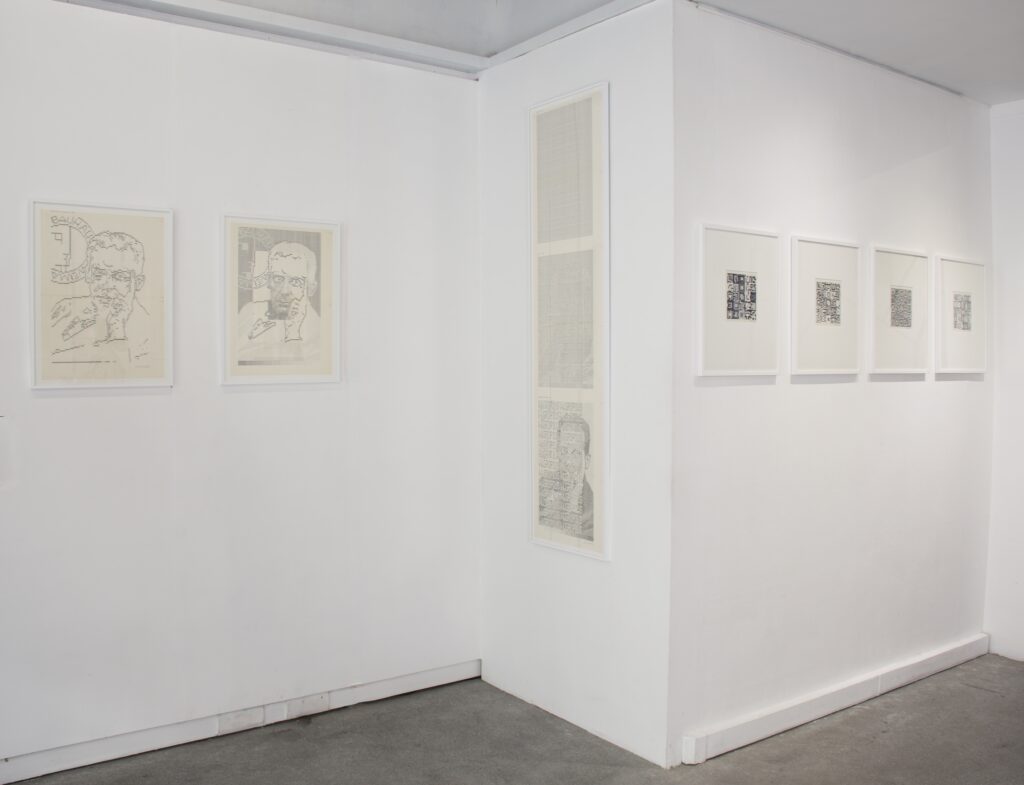
RCM Galerie is pleased to present Chihaya Shimomura, the first exhibition outside Japan devoted to one of the pioneers of computer art. Working in Tokyo from the early 1960s, Shimomura was among the first artists anywhere to treat a picture as the output of a procedure rather than the work of a hand, and he pursued that single idea across three media over nearly two decades, from drawing to FORTRAN to a programming language of his own design.
Born in Hiroshima in 1941, Shimomura trained at Nihon University and the Tokyo University of the Arts, where he received a Bauhaus-system design education at first hand from Iwao Yamawaki, who had studied at the Bauhaus Dessau in the early 1930s. He went on to work for seven years alongside Hiroshi Kawano, the philosopher who introduced Max Bense’s information aesthetics to Japan. In October 1970 the two mounted the Computer Art Exhibition at the Plaza DIC in Nihonbashi, the first public presentation of Kawano’s K-system.
The exhibition brings together three bodies of work made between 1961 and 1978, shown together for the first time.
The drawings of 1961 and 1962, in pen and china ink on card, were made in his Tokyo apartment in near-total isolation from the European geometric movements then forming in Paris and Düsseldorf. Shimomura knew the work of Victor Vasarely and corresponded with Josef Albers, who wrote back and sent works of his own in return, but he had not seen Bridget Riley, and op art did not yet carry a name. The Responsive Eye at the Museum of Modern Art was four years away. The drawings were never publicly exhibited and have remained a closed body of work until now.
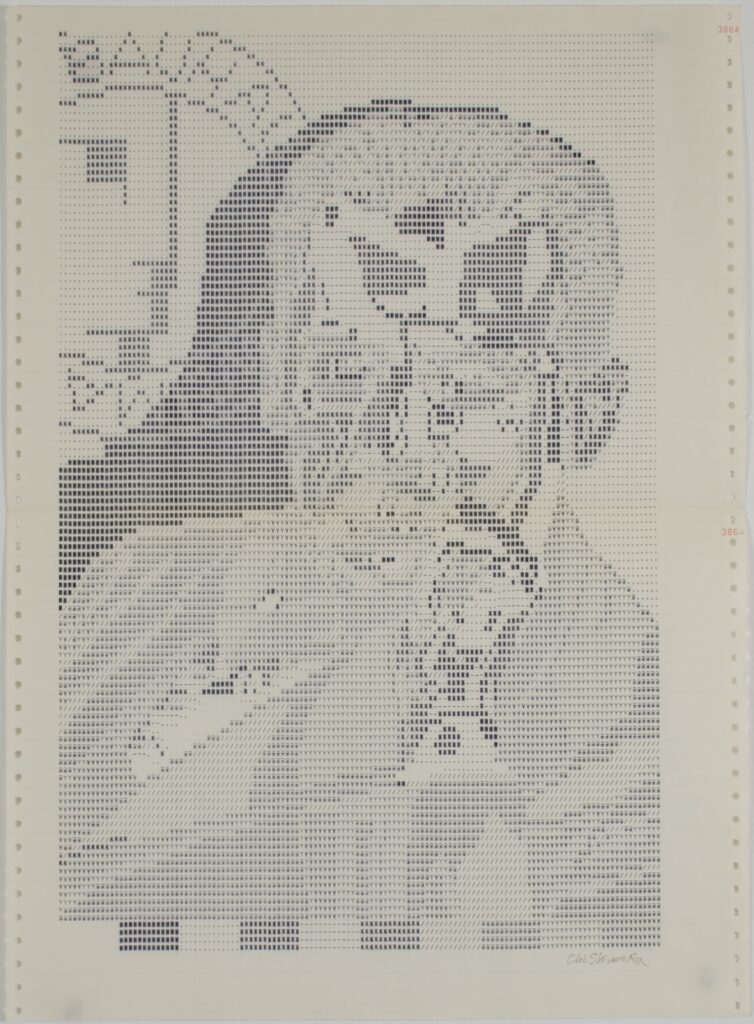
The portraits of 1973 grew from a single problem. Working without a scanner, Shimomura laid a ruled grid of acetate over a photograph of Walter Gropius reproduced in Hans Wingler’s Das Bauhaus, read the tonal value of each cell by eye, and transcribed the image into a column of digits keyed onto punched cards. He then ran the data through a library of forty FORTRAN subroutines of his own on a HITAC mainframe at the Tokyo University Computation Centre. The resulting line-printer sheets, bearing the header TRANSFORMED OR DEFORMED PICTURE, appeared only in two Musashino research bulletins and have never been seen outside Japan.
By 1978 he had built PLPT, the Programming Language for Picture Transformation, an authoring system that let designers compose images by writing legible instructions in something close to ordinary English. The geometric plotter works in the exhibition are its output. They return Shimomura to the abstract territory of the 1961 drawings with an instrument that could now execute by program what the hand had once carried out.
The three groups trace a single idea worked out over seventeen years: that a picture is defined by the operation that produces it. They have not been shown together in this configuration before.